What Is a Birth Chart and What Does It Reveal First?
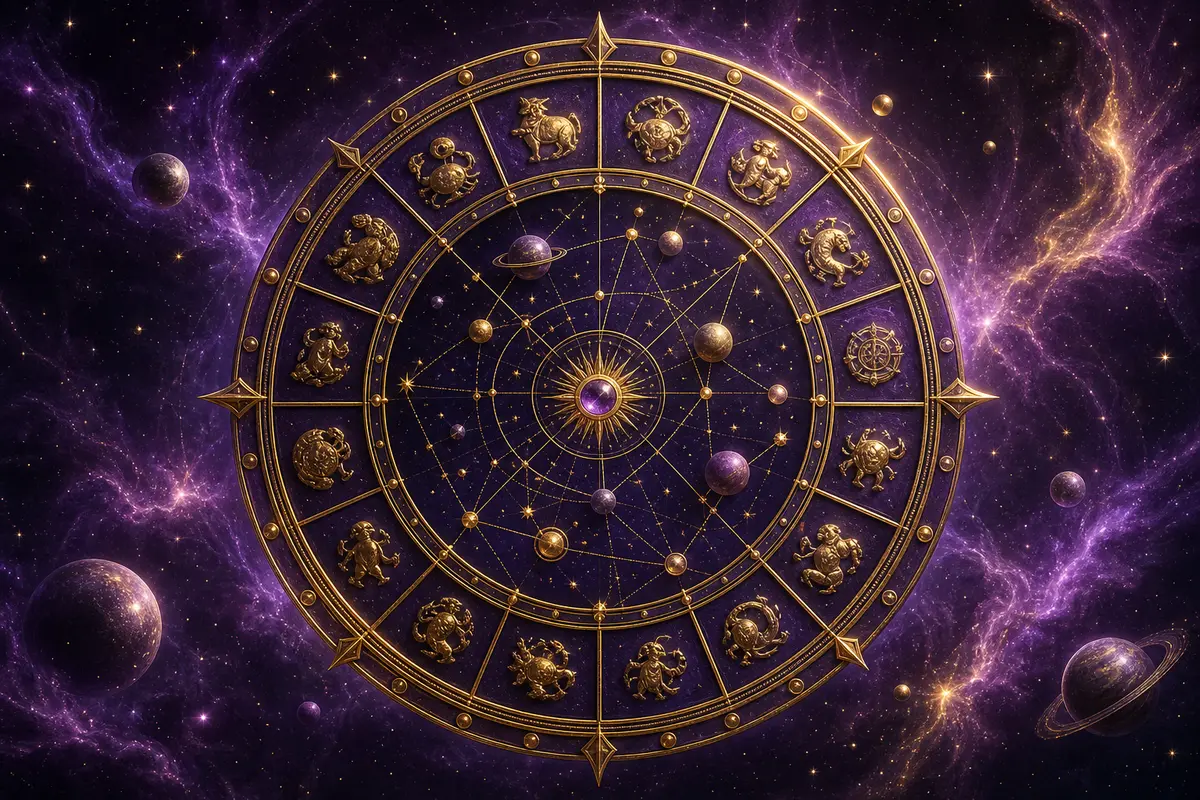
Imagine the sky freezing for a single moment — the moment you were born. The Sun in one sign, the Moon in another, each planet at a precise point along its path. A birth chart, also called a natal chart, is the symbolic snapshot of that moment, calculated from your date, time, and place of birth. In astrology, it serves as the foundational map for exploring your tendencies, strengths, and recurring life themes.
Let us be clear from the start: a birth chart is not a script of your fate. It does not decide who you are or what will happen to you. Think of it instead as a symbolic language — a mirror that helps you look at yourself from a fresh angle. In this article, we walk through the building blocks of the chart and what to focus on when you look at one for the first time.
The Anatomy of a Birth Chart
Technically, a natal chart is a two-dimensional drawing of the sky as seen from your birthplace at your birth moment. Around the wheel sit the twelve zodiac signs; inside it, the Sun, Moon, and planets occupy their exact positions. The wheel is further divided into twelve “houses” — areas of life — and the geometric relationships between planets, known as aspects, are drawn as connecting lines.
Each layer answers a different symbolic question:
- Planets ask “what?” — which drive, function, or need is at work.
- Signs ask “how?” — the style and flavor in which that energy expresses itself.
- Houses ask “where?” — the area of life where it becomes most visible.
- Aspects ask “how do they talk to each other?” — flow, friction, and dialogue between energies.
The Big Three: Sun, Moon, and Rising Sign
When astrologers glance at a chart for the first time, they usually begin with three placements often called “the big three.”
Your Sun sign is what most people mean when they say “my sign.” It represents the core of your identity — the central theme your vitality keeps returning to. Your Moon sign describes your inner emotional world: what nourishes you, how you seek safety, and which instincts surface under stress. Your rising sign, or Ascendant, is the sign that was climbing over the eastern horizon at the moment of your birth; it colors first impressions, your outward manner, and the doorway through which you meet life.
Read together, the big three often explain why standard Sun-sign descriptions never quite fit. Someone with the Sun in Capricorn and the Moon in Pisces, for example, may appear disciplined and composed while carrying deep emotional sensitivity within. The chart makes these layers visible instead of flattening them into a single label.
Planets, Houses, and Aspects: The Deeper Layers
Beyond the big three, the chart keeps unfolding. Mercury reflects how you think and communicate, Venus how you relate and what you value, Mars how you act and assert yourself. Jupiter and Saturn describe the balance between expansion and structure, while Uranus, Neptune, and Pluto speak to generational and transformational themes.
The houses set the stage for these energies. The first house relates to identity and presence, the fourth to roots and family, the seventh to one-to-one relationships, the tenth to career and public role — and so on across twelve areas of life. The same planet tells a very different story depending on the house it occupies. Aspects, meanwhile, are the conversations planets hold with one another: a conjunction concentrates energies, a trine suggests ease and flow, and a square points to a productive tension that invites growth. No aspect is inherently “good” or “bad” — each simply highlights an area worth your awareness.
Why Your Birth Time Matters So Much
Your rising sign and house placements depend directly on your time of birth. The Ascendant shifts into a new sign roughly every two hours, and even a few minutes can move house boundaries. A few practical tips:
- Verify your birth time from official records or family members whenever possible.
- If the time is unknown, a chart can still be calculated — the rising sign and houses are simply set aside, and the reading focuses on planet-sign placements and aspects.
- If you only know an approximate time, say so; an experienced reader can distinguish which parts of the interpretation remain reliable.
Curious about your own sky? You can create your free birth chart in minutes using your birth details and see your chart wheel and key placements laid out clearly.
Reading Your Chart Responsibly
At its best, a birth chart is a tool for self-awareness. It exists not to label you but to help you notice your patterns, own your strengths, and approach your challenges with more compassion.
The chart describes tendencies, not outcomes. The same placement can be lived at very different levels of maturity, and your choices and effort remain the largest part of the equation. Steering away from fear-based, absolute pronouncements is one of the most important forms of self-care in this field.
At first glance, a chart can feel overwhelming — a maze of glyphs, lines, and degrees. Exploring it with an experienced guide can make the process both clearer and more enjoyable. If you would like company on that journey, you can browse our consultants and find an advisor who resonates with you, then explore your chart together in a calm, unhurried conversation.
Remember: your birth chart is not the sky’s final word about you. It is the opening line of a deeper conversation with yourself.